See Well, Move Better: Why Your Vision May Be the Missing Piece of Your Fitness
- Marlee Aimone
- Jul 15
- 4 min read
By Marlee Aimone, General Manager & Coach, Athlon Fitness & Performance
When most people think about improving their health, they focus on getting stronger, losing weight, eating better, or increasing endurance. Those are all important goals, but there’s another system that has a tremendous impact on how your body performs every day.
It’s your vision.

At Athlon Fitness & Performance, we believe fitness is about much more than exercise. Our mission is to help people look, feel, and perform at their best so they can continue doing the things they love throughout their lives. Whether that’s hiking, golfing, traveling, playing pickleball, or keeping up with children and grandchildren, your body should support your lifestyle, not limit it.
That’s why we developed our Five Pillars of Lifelong Athletic Development: MOVE WELL, SEE WELL, BALANCE WELL, BREATH WELL, and LIVE WELL.
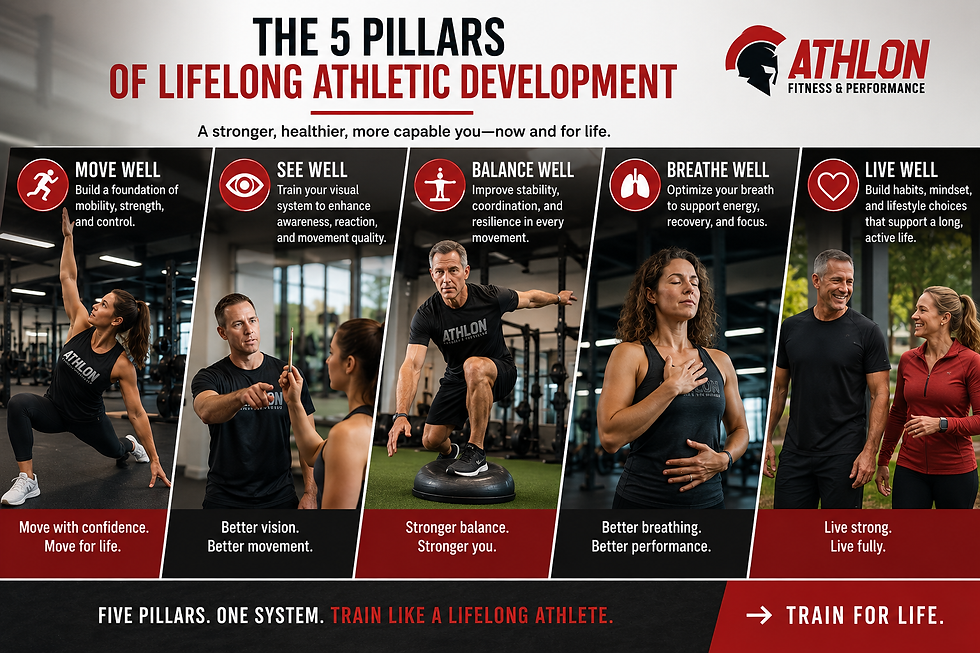
In a previous article, we explored the importance of Move Well and how quality movement depends on strength, control, and coordination. Today, we’re taking a closer look at the second pillar: See Well.
Vision Is More Than Eyesight
Most people think vision simply means seeing clearly or whether they need glasses.
In reality, your visual system is one of your brain’s most important sources of information.
Every second of every day, your brain is constantly asking questions such as:
Where am I?
What’s moving around me?
Is this environment safe?
How should I respond?
Your eyes answer those questions before your muscles ever move.
That’s why we often say:
Better vision creates better movement.
Your Brain Is Always Trying to Protect You
Your brain’s primary responsibility is survival.
Imagine you’re hiking and notice something lying across the trail ahead. For a brief moment, your brain can’t decide whether it’s a stick or a snake.
It doesn’t wait for certainty.
Instead, your body immediately becomes more protective. Your muscles tighten, your posture changes, your movements become more cautious, and your confidence decreases.
Your muscles didn’t make that decision.
Your brain did.
The same thing can happen in everyday life. When your visual system isn’t providing clear, reliable information, your brain often responds by creating protective movement patterns that may include:
Increased muscle tension
Poor posture
Reduced balance
Slower reactions
Less efficient movement
Sometimes even pain
Many people assume these changes are simply part of getting older.
Often, they’re a response to the quality of information your brain is receiving.
Sports Vision Isn’t Just for Athletes
When people hear the phrase sports vision, they often imagine professional athletes training their reaction time.
In reality, sports vision is simply your ability to gather visual information, process it efficiently, and turn it into movement.
That happens every day when you:
Walk down stairs
Step off a curb
Drive through traffic
Navigate a crowded room
Play pickleball or golf
Catch something tossed your way
Hike uneven trails
Nearly every movement begins with your eyes collecting information before your body reacts.
The Connection Between Vision and Balance
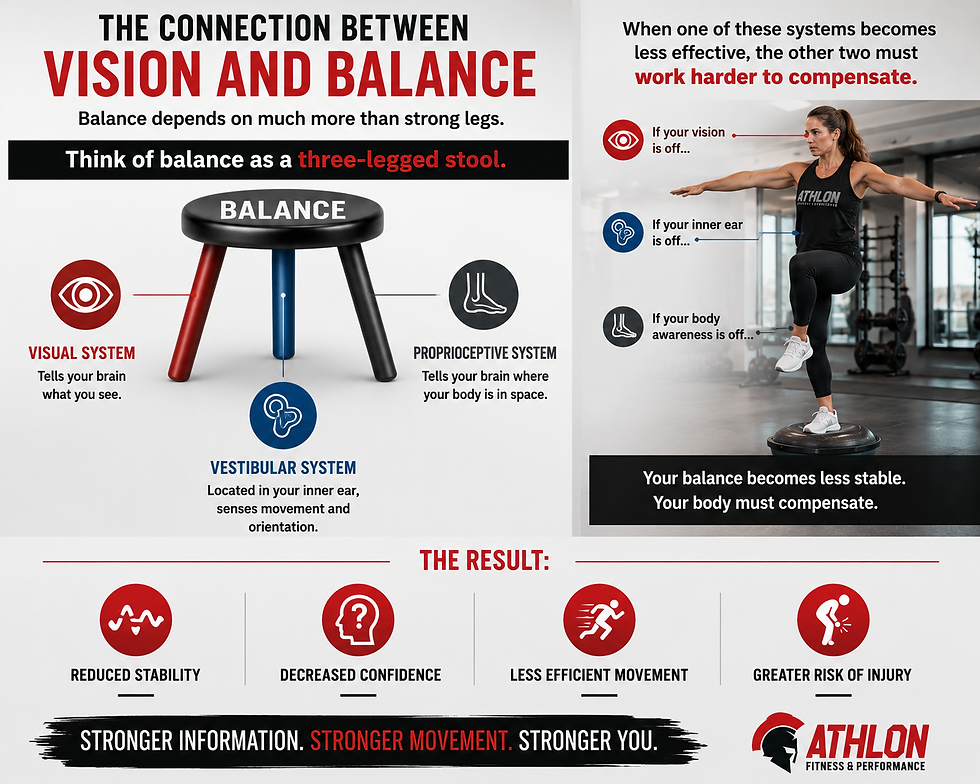
Balance depends on much more than strong legs.
Think of balance as a three-legged stool.
One leg is your visual system, which tells your brain what you see.
The second is your vestibular system, located in your inner ear, which senses movement and orientation.
The third is your proprioceptive system, which tells your brain where your body is in space.
When one of these systems becomes less effective, the other two must work harder to compensate.
The result is often reduced stability, decreased confidence, and less efficient movement.
Aging Doesn’t Mean You Have to Accept Decline
As we age, it’s common to notice changes in how quickly our eyes adjust between light and dark, react to movement, or process visual information.
But those changes don’t necessarily mean we have to give up the activities we enjoy.
Just as we can strengthen muscles through training, we can also challenge and improve how our brain and visual system work together.
The goal isn’t simply living longer.
The goal is remaining capable.
Remaining independent.
Remaining confident.
A Simple Exercise to Experience the Connection
Here’s a quick exercise you can try at home.
First, raise both arms overhead and notice how your shoulders feel. Then reach one hand behind your head and the other behind your back to check your shoulder mobility. Simply notice your current range of motion without forcing anything.
Next, hold a pencil or your thumb at arm’s length directly in front of you.
Keep your eyes focused on the tip as you slowly bring it toward your nose, then extend it back out. Repeat five times with one hand, then switch hands and repeat five more times.
Now test your shoulder movement again.
You may notice a little more range of motion.
You may feel smoother movement.
Or you may notice no change at all.
That’s perfectly okay.
The point isn’t that one exercise fixes everything.
The point is that changing the information your eyes send to your brain can sometimes change how your body organizes movement almost immediately.
We Don’t Guess. We Assess.
One of our core philosophies at Athlon Fitness & Performance is simple:
We don’t guess. We assess.
Before building a fitness plan, we evaluate all five pillars of Lifelong Athletic Development to understand how each person’s body functions.
From there, we create a personalized roadmap based on individual goals, injury history, movement quality, and current abilities.
No two people move the same.
No two people should train exactly the same.
One of the greatest transformations we see isn’t simply stronger muscles or better endurance.
It’s confidence.
When people understand how their body works and begin seeing measurable progress, they stop focusing on what they can’t do.
Instead, they begin focusing on everything they can do.
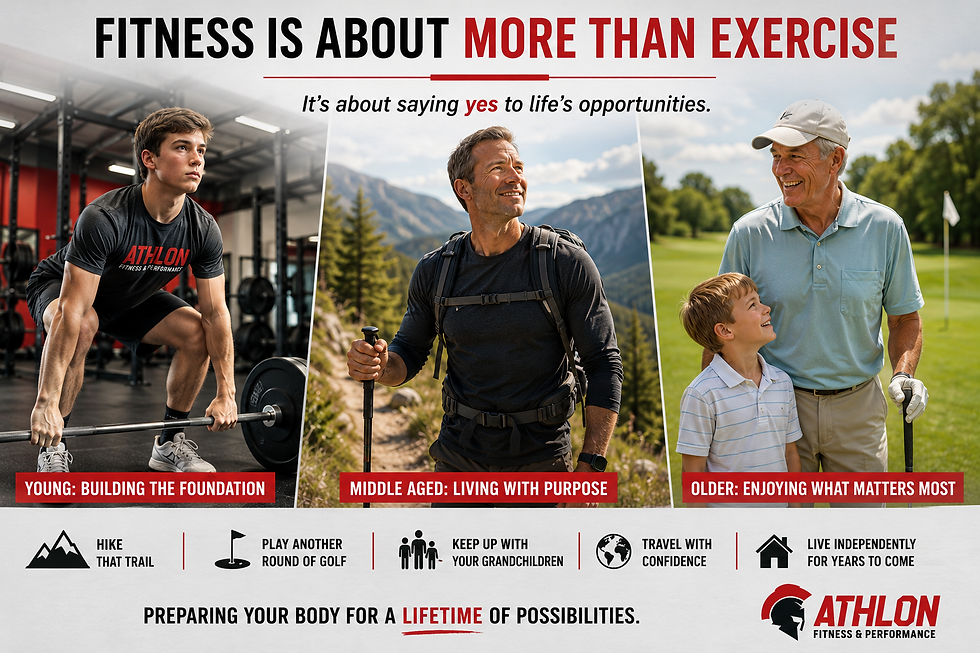
At the end of the day, fitness isn’t just about lifting heavier weights or looking better in the mirror.
It’s about saying yes to life’s opportunities.
It’s about hiking that trail.
Playing another round of golf.
Keeping up with your grandchildren.
Traveling with confidence.
Living independently for years to come.
Because becoming healthier isn’t about preparing for one event.
It’s about preparing your body for a lifetime.
About the Author
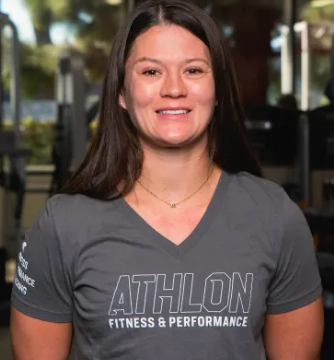
Marlee Aimone is the General Manager and Coach at Athlon Fitness & Performance in Paso Robles, California. Through Athlon’s Lifelong Athletic Development system, she helps individuals build stronger, healthier, and more capable bodies so they can continue enjoying the activities they love for years to come.


Comments